
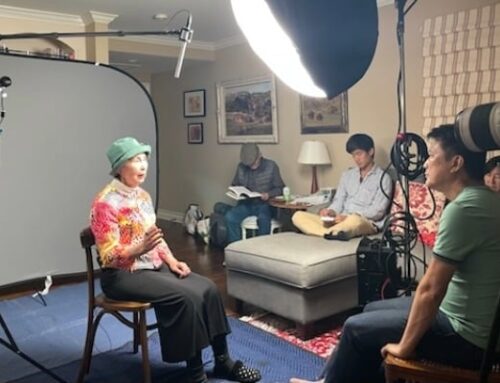
The film crew of five arrived at my house on a sunny July morning to shoot interviews of my parents for KoreanAmericanStory.org, a non-profit organization dedicated to record and collect stories of Korean Americans. They unloaded large suitcases of audio and visual equipment, poles, backdrops, and lights, and hauled them up to the second floor of our LA home to record the first of two interview sessions scheduled for the day. The first was to conduct a Legacy Project interview of each of my parents about their life stories and reflections. The second was to capture me interviewing my parents about their experiences in North Korea before the country was divided as part of the Letters to My Hometown Project.


KoreanAmericanStory.org founder, HJ Lee, graciously invited our family to participate in these interviews after I reached out to him through a mutual friend. I had known about HJ’s organization for a long time and was thrilled to be able to document my 88-year-old father and 86-year-old mother’s stories for my children and future generations. I also hoped to deepen my research for my historical novel-in-progress, RED SEAL, which is inspired in part by my family’s connection to what is now North Korea.
HJ conducted the individual interviews of my parents for the Legacy Project portion. My father talked about his childhood in Japan, his migration to Manchuria during WWII, and attending a communist school in North Korea before escaping to South Korea through the mountains at night. My mother spoke about growing up in Seoul, moving to Pyongyang before the country was divided, and her family’s odyssey fleeing to the south by sea.
Although I had heard these stories before, listening to them through these interviews allowed me to discover nuances of their stories I never knew before. I was grateful that my parents agreed to participate in the interviews, share milestone photos and documents, and speak openly about their personal lives so their stories wouldn’t be lost.


The crew took a midday break, and we ate a delicious Korean doshirak boxed lunch out on the terrace together. The team dismantled the set upstairs and found another spot downstairs in the family room for me to interview my parents—the highlight of the afternoon session. I had interviewed my grandmother for WHITE MULBERRY before she passed, but I never dreamed I would have the opportunity to interview my parents on film. My grandmother’s interviews were conducted on a cassette recorder and a small audio recording machine. This was a whole different affair!
The aim of the Letters to my Hometown Project is to preserve and share the stories of elder Korean Americans with direct memories of the Korean War and the younger generations who inherited the legacies of their family’s past. In preparation for the interviews, my parents were asked to write an imaginary letter to their hometown. They both wrote about their respective escapes from North Korea when my mother was seven and my father was nine. During the interview, I asked them what it felt like to write those letters.


My mother said that she remembered her family’s time in Pyongyang as idyllic because her father would take them up to the mountains every night to enjoy dinner. But when her family returned to Seoul, her father was labeled a communist, thrown in prison, and she was unable to afford college. My father said that his first language was Japanese but when he lived in Sinuiju, he developed a North Korean accent. When he and his single mother made it to the south, my father was teased relentlessly for the way he spoke and developed poor self-esteem.
I commented to my parents that it was astonishing that they were both living in North Korea as children around the same time, though living very different lives. I also reflected that they were both about the same age when they fled North Korea that I was when I immigrated to the US at seven. I told them how conflicted I felt as a little girl coming to a new country unable to speak the language, and my regret at losing my ability to communicate in Korean, especially with them, as I lost my Korean over time.


Could it be that my mother, father, and I share more in common than I thought? Is our shared family history one of displacement at a young age—one that required each of us to cope with the challenges that migration presented in our respective lives? I discussed this with my parents, and we all agreed it was true. The revelation that my parents were refugees, and I was an immigrant when we were all young children was eye-opening for me. I felt a deeper connection to my parents than ever before. I think they did too.
As a final question, I asked my parents what message they wanted to leave for their grandchildren. My mother’s message was to think about others before themselves. My father’s message was to talk to each other right away if something is wrong so there’s no misunderstanding. My message was to always communicate our feelings. Even though my parents, my husband, and my children don’t share a common language where we are all fluent, we can use simple tools like Google Translate and ChatGPT to write notes and messages, and emojis to make our feelings known❤️😍. And say “I Love You” a lot!


As the film crew packed up and we said our final goodbyes with a clink of glasses, my heart brimmed with joy at the silence that was broken and the trust formed in my family that day. My parents and I opened up, perhaps more than we ever have, and I believe we will continue to carry on these kinds of conversations in the future. It’s never too late to use stories to build bridges and heal. That’s why I’m writing my next book too. Thank you, Mom and Dad. And thank you Korean American Story!
Speaking of next book, I finished a rough draft of my second novel this month! It was a big moment to type the words THE END, especially at our lake house in Maine where we spend every summer and have wonderful memories. I know I still have a lot of work to do in revising and polishing this draft, but I know these interviews will help. I learned a lot more about this period of history through my parents’ personal struggles, which will add depth to my narrative. More importantly, I learned to create space for mutual listening and sharing, which will enrich all my relationships going forward.

If you have an opportunity to interview your family, what would you do? Would you ask them to share a picture from their childhood and what they remember about it? Would you perhaps ask them to write an imaginary letter to their hometown and how they felt as they wrote it? Please leave a comment below to share.
Thank you for following along!
Past and Upcoming Events
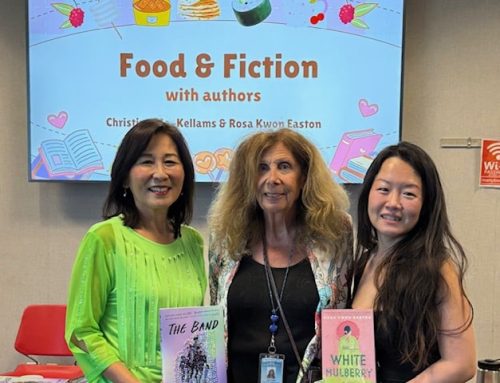
I had a great time at speaking at my childhood library, Torrance Public Library, where I talked about the role libraries played in my life and led me to write books of my own. I will be speaking next at Southwest Harbor Library in Bar Harbor in my lovely, adopted home state of Maine! I hope you’ll be able to join me and fellow debut author Hyeseung Song, celebrate the launch of Hyeseung’s paperback! You can find out more on my events page and see a video shared by the Torrance Public Library.


What I’m Reading

Brothers at War: The Unending Conflict in Korea
By Sheila Miyoshi Jager
Seventy-five years after North Korean troops crossed the 38th parallel into South Korea, the Korean War has not yet ended. This book is one of the most accessible and balanced non-fiction accounts of the Korean War I’ve ever read. It’s been invaluable for my research for RED SEAL because it brings to life the complexities of the war and the repercussions this conflict has had on the lives of ordinary people.


P.S. And congratulations on finishing the first draft of your next novel — can’t wait to read that, too!
Thank you so much Jackie! Hope our paths cross again soon!